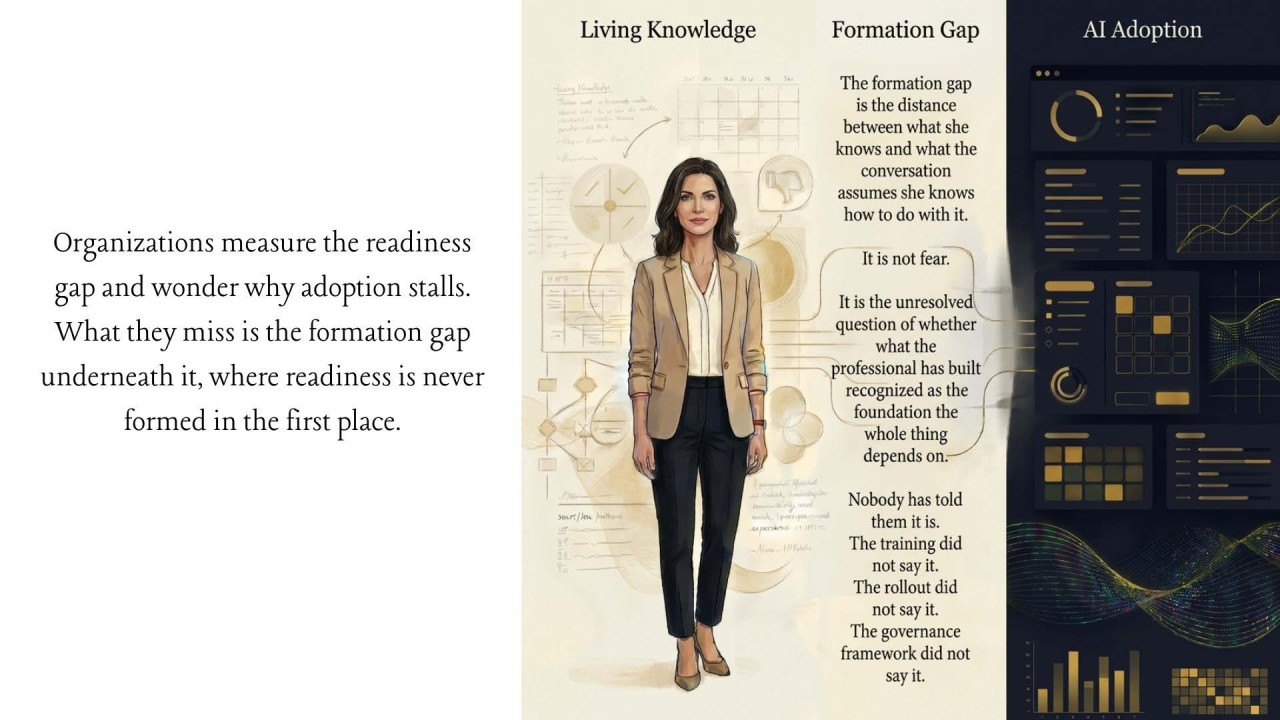
Most organizations measure adoption from the moment a professional logs in. What they miss is everything that happens before that, the internal negotiation running quietly underneath the surface of someone who has spent fifteen or twenty or thirty years building something real. She is sitting in the demo, watching the rollout, nodding through the training. From the outside, she is present. What is actually running is a question she has not said out loud: whether the future she is watching unfold still has a place for her in it.
AI adoption does not fail at the tool. It fails before the professional decides she belongs in the future the tool represents. Calling that a training problem misses the point entirely. What lives in that space is something different. Not before the AI tool, but before the decision to try. A formation gap. The one layer almost no AI governance conversation is built to reach. This is not resistance. Resistance pushes against something. The formation gap happens before a professional has even decided whether to engage at all.
The Numbers Already Know It
ManpowerGroup's 2026 Global Talent Barometer, drawn from thousands of workers across multiple countries, found that regular AI usage rose by 13% in 2025 while confidence in using it dropped by 18% over the same period. Among Baby Boomers, confidence fell by 35%. Among Gen X workers, it fell by 25%.
Usage went up. Confidence went down. The most experienced professionals in the workforce are using tools they do not trust, handed to them without the human readiness infrastructure that would make that trust possible. What those numbers describe is not a training deficit. Most training is not designed to reach what happens before a professional decides to engage at all. The gap forming underneath those statistics is a formation gap, one that precedes training, precedes policy, and precedes most governance structure organizations are building around responsible AI use.
The EY 2025 Work Reimagined Survey, covering 15,000 employees and 1,500 employers across 29 countries, put a number on what that costs. While 88% of employees report using AI in their daily work, only 5% use it in advanced ways. The rest are using it for search, summarization, the kinds of tasks that require no real engagement with the tool at all. EY estimates organizations are missing up to 40% of potential AI productivity gains because the human side of adoption has not been addressed. The technology is deployed. The tools are available. The return on investment is not materializing because the professional was never reached before the tool arrived.
The formation gap is not the same as the readiness gap organizations are already measuring. The readiness gap shows up in adoption data, completion rates, and ROI reports. It tells an organization where performance is falling short. The formation gap lives underneath that number. It is the space a professional occupies before she can move toward readiness at all, the distance between the Living Knowledge she carries and a conversation that was never designed to receive it. Organizations attempt to close the readiness gap with training and tools. What they encounter instead is the formation gap underneath. That is why the training does not hold.
What Is Running Beneath the Surface
The formation gap does not announce itself and that is precisely what makes it so difficult to address. The professional looks fine. She is attending the sessions, completing the modules, nodding in the right places. On every visible metric, adoption is proceeding as planned.
What is running beneath the surface is something I call Quiet Technophobia®. Not loud resistance. Not dramatic refusal. The unspoken, internalized experience of a professional who senses that the world is advancing without her and has no language for what she is feeling. It shows up as the LinkedIn post she reads and scrolls past without engaging, the training she completes and does not apply, the AI platform her organization deploys that she opens once, quietly closes, and does not return to.
Quiet Technophobia is not a character flaw. It is a natural human response to a shift that arrived without accounting for people like her. When it is present, it blocks access to something she already carries: the capacity to engage with technology from a place of grounded expertise. The formation gap is not the absence of that capacity. It is what happens when something blocks access to it before the professional ever touches the tool.
That distinction matters because it changes what the solution has to be. A capability problem closes with training. A formation problem requires something different, something that reaches the professional before the tool does. This professional is not behind. She is unaddressed.
What Governance Is Missing
In October 2025, Gartner delivered a finding to thousands of CIOs and IT executives that should have changed every AI deployment conversation that followed. By 2030, according to the CIOs Gartner surveyed, 0% of IT work will be done by humans without AI. To capture the value of that shift, organizations need to focus on a combination of AI readiness and human readiness. Their finding: few organizations are doing both.
The space between AI readiness and human readiness is exactly where the formation gap lives. Technical governance addresses what the system can do and who can access it. Policy governance establishes the rules. Compliance governance audits them. These layers are not designed to reach the professional who has not yet decided, privately and without language, whether any of this is for someone like her.
Mindset Intelligence™ is the layer that belongs before all three. It addresses who the professional is before she sits down to use the tool, and whether she has been reached in the space before it arrives. Organizations that skip this are not saving time. They are deploying AI on top of an unaddressed formation gap and calling the result an adoption problem.
What Lives on the Other Side
The formation gap is crossable. Moving through it, not around it, produces something Gartner named but did not solve: human readiness that actually holds. The professional enters an AI interaction organized around her intent rather than her hesitation. She evaluates outputs the way she evaluates ideas from colleagues, with the same discernment she has been applying to her work for decades. She stays inside the interaction, builds, redirects the system toward what she actually needs. The tool has not changed. Her relationship to her own expertise has.
What the formation gap was guarding was never the technology. It was the professional's recognition that she is the intelligence in the equation, that the accumulated judgment built through years of real work is what the AI interaction depends on and cannot replicate or replace. She does not arrive at that recognition through a training module. She arrives at it through a path that addresses formation first.
What This Means for Organizations
A well-governed AI platform deployed to professionals who are still privately negotiating their own relevance is not, in any real sense, well-governed. The professionals most likely to be sitting in the formation gap are also the ones carrying the most institutional knowledge, the judgment, the context, the pattern recognition that makes AI outputs worth anything in the first place. They are not behind. They are waiting for a conversation that has not happened yet, one that starts before the tool, before the training, before the policy.
The formation gap will not announce itself. It will continue to look like everything is fine right up until the adoption metrics, the ROI reports, and the productivity numbers say otherwise. Organizations are not failing to deploy AI. They are deploying it into a space they have not prepared. Until that changes, the data will continue to reflect what professionals already know.
To learn more, visit my website: inclus-ai.com