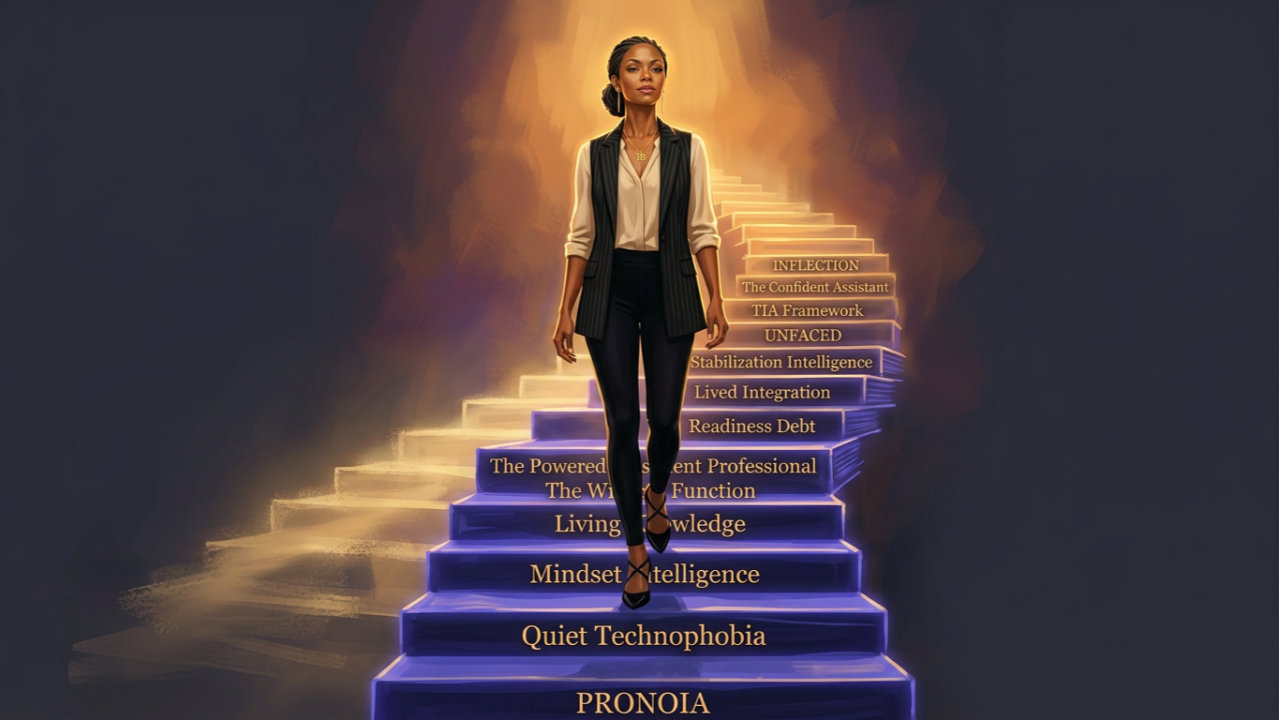
The workforce conversation about AI has spent years asking who adopted and who did not. Almost nobody is asking what happened to the professionals who went all the way through the transition and came out the other side as something the enterprise still has no category for yet. I am one of them and I want to tell you what I found.
My journey into AI was never really about learning the technology. I understand that now in a way I could not have named at the beginning. What it was actually about was discovering the true location of my value.
At the start, I approached AI the way many mid-career professionals do, from the outside looking in, watching the speed of the conversation, watching people speak fluently about systems, prompts, automation, agents, and workflows, trying to determine where someone like me fit inside a transition that initially appeared engineered for technical people. Underneath all of that was the quieter question I eventually became brave enough to name: what happens to the kind of intelligence I carry?
Not coding intelligence or startup visibility, but operational intelligence, the human kind, built from pattern recognition, context management, and the ability to keep systems functioning even when nobody notices the architecture holding them together.
What I did not come from was technical authority. I came from adaptive authority and that distinction matters. Many people in AI spaces build credibility through technical depth. I built mine through interpretive depth. I learned how to translate complexity into emotional accessibility, identify invisible workforce patterns, connect operational breakdowns to identity disruption, and recognize that adoption failure is often a dignity problem before it is a skill problem.
What is often overlooked in transitions like mine is that proximity to human systems trains a very specific intelligence. I spent years inside environments where work succeeds or fails based on invisible coordination, not just tasks getting completed but people staying aligned under pressure, priorities shifting in real time, emotional atmospheres changing meetings before words are spoken. I learned how organizations actually behave beneath org charts, how information moves socially before it moves operationally, how fear disguises itself as resistance, and how institutional continuity depends on people no system formally accounts for.
Most AI conversations were being led by people looking at organizations structurally. I was looking at them behaviorally and that is where Quiet Technophobia® came from, not from research alone but from observation, from sitting inside the workforce layer itself and watching what happened to people who were never brought into the conversation properly.
Some people either suppress their discomfort, perform confidence, or disengage entirely. I studied my own transition while I was moving through it, which made me both participant and observer simultaneously. I tracked the shift from fear to curiosity, from curiosity to capability, from capability to articulation, from articulation to framework creation, following the sequence instead of just surviving it. That is why the work eventually shifted from exploration into purpose.
Because at first, like many professionals, I unconsciously treated AI as the intelligence and myself as the user standing outside of it. But over time my relationship with the technology changed. I stopped approaching it like a machine to impress and started approaching it like infrastructure capable of extending the intelligence already present inside me. I realized my value was never the task itself. It was the judgment underneath the task, the discernment, the relational awareness, the ability to hold competing realities at once and still move something forward coherently. AI did not create those capacities in me, it exposed them.
That is why my work evolved from curiosity into authorship. I was not merely experimenting with prompts. I was externalizing cognition. Every framework I built, every naming construct, every articulation around readiness, Quiet Technophobia®, Living Knowledge, the Witness Function, and the Powered Persistent Professional, was part of me slowly recognizing something larger. My mind was never secondary to the system; it has been the governing layer all along.
That is the deeper meaning behind the realization I want to leave you with. Your mind is the infrastructure, not the tool, not the platform, not the prompt library. The enduring asset is not the technology. It is the human architecture capable of directing the technology meaningfully.
Yet the persistence required to arrive at that realization is not simply survival. It is consistency. The realization was never simply that my knowledge matters. It became that my knowledge could remain present, operational, and useful beyond the limits of my physical presence through frameworks, language, constructs, and voice. I am no longer only carrying the experience privately. I am creating pathways through it for other people. My personal adaptation became collective infrastructure, not digital immortality, not branding, but witness, language, orientation, and a stabilizing voice inside a destabilizing transition.
For many professionals still trapped inside unnamed Quiet Technophobia, this work becomes evidence that you are not failing, you are not unintelligent, you are not too late, and your professional value does not disappear simply because technology is accelerating. I became the person I needed when I first entered the conversation. That is the real closing of this arc and it is also the opening of yours.
To learn more, visit www.inclus-ai.com.