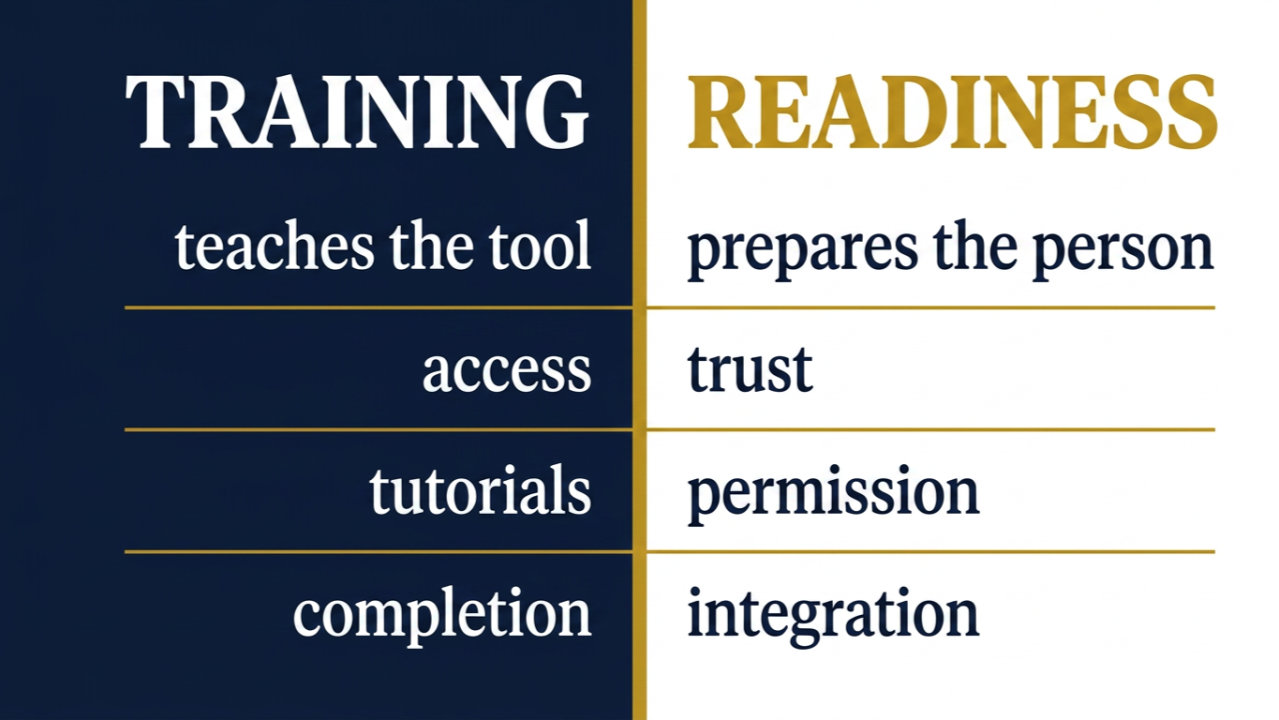
In June, a global study of 1,100 business and technology leaders confirmed something many experienced professionals have already lived but have not had language for: training can end while readiness remains unfinished.
Kyndryl's 2026 People Readiness Report found that only 23% of organizations say their workforce is ready for AI. That number dropped six points from last year, while AI deployment was accelerating and organizations were investing more, training more and rolling out more than they ever had before. More activity and less readiness, happening at the same time.
That finding is not a data irregularity. It is a structural diagnosis, and if you are the professional who has completed the training and still cannot fully explain why something feels incomplete, this issue is for you.
The pain nobody is naming
You showed up, attended the sessions, completed the modules, clicked through the certification and logged the hours. You did everything the program asked of you. Then you went back to your desk, opened the tool and felt the difference between being trained and being ready. Not incompetence, and not confusion about how the technology works. Something quieter and more specific than that: a sense that the program described a version of readiness that did not quite match the person sitting in the chair.
This is what Quiet Technophobia® looks and feels like from the inside. Not loud resistance, not refusal, not a lack of intelligence or effort. Just the quiet, persistent sense that the program finished and you did not, that everyone else seemed to land somewhere you have not landed. Yet, that the tool is open on your screen and something still does not feel integrated. The organization measured completion. It did not measure that.
Why the gap exists
There are three distinct things that should be happening in every AI rollout and most organizations are treating all three as the same investment:
Readiness is formation. It is the work that happens before the tool arrives, before the rollout, before the first training session. It is the internal groundwork that makes adoption possible: clarity about how you work, confidence in your professional judgment, and a relationship to your own knowledge that is strong enough to hold when the tool changes what is expected of you.
Change management is transition. It is the structured process of moving people through a shift in how work is done. It is legitimate, necessary, and completely different from the formation work underneath it.
Adoption is outcome. It is the metric most organizations are already measuring: participation, completion, usage and compliance.
When organizations treat all three as the same investment, the employee pays the price that the measurement cannot see. They complete the milestone, log the activity, move through the transition and arrive on the other side of the rollout still carrying the gap the dashboard never had a category for.
ManpowerGroup's 2026 Global Talent Barometer found that AI adoption in the workplace has risen significantly while worker confidence in using technology has declined sharply. That is what it looks like when the outcome metric improves and the formation layer was never built.
What can happen now
The organizations that close this gap will not simply be the ones running more training. They will be the ones asking a different set of questions:
whether their people were formation-ready before the program began, whether employees understood where their judgment still mattered
whether existing expertise had been translated into AI-supported workflows
whether people had language for the hesitation and uncertainty that training completion does not capture
This conversation can start at any organizational level. You do not have to wait for the next rollout, the next dashboard or the next training module to name what is missing.
The future of AI adoption will not be won by the organizations that train the most people the fastest. It will be won by the organizations that understand what the training could not finish. That is the work of readiness, not another module, not another checklist, but the formation layer underneath adoption. That is where PRONOIA begins.
Traci Brown, Founder of InclusAI and creator of PRONOIA, the readiness framework built for the formation layer most AI strategies skip.
Where in your AI rollout did you assume readiness instead of building it? Start here: https://inclus-ai.com/readiness