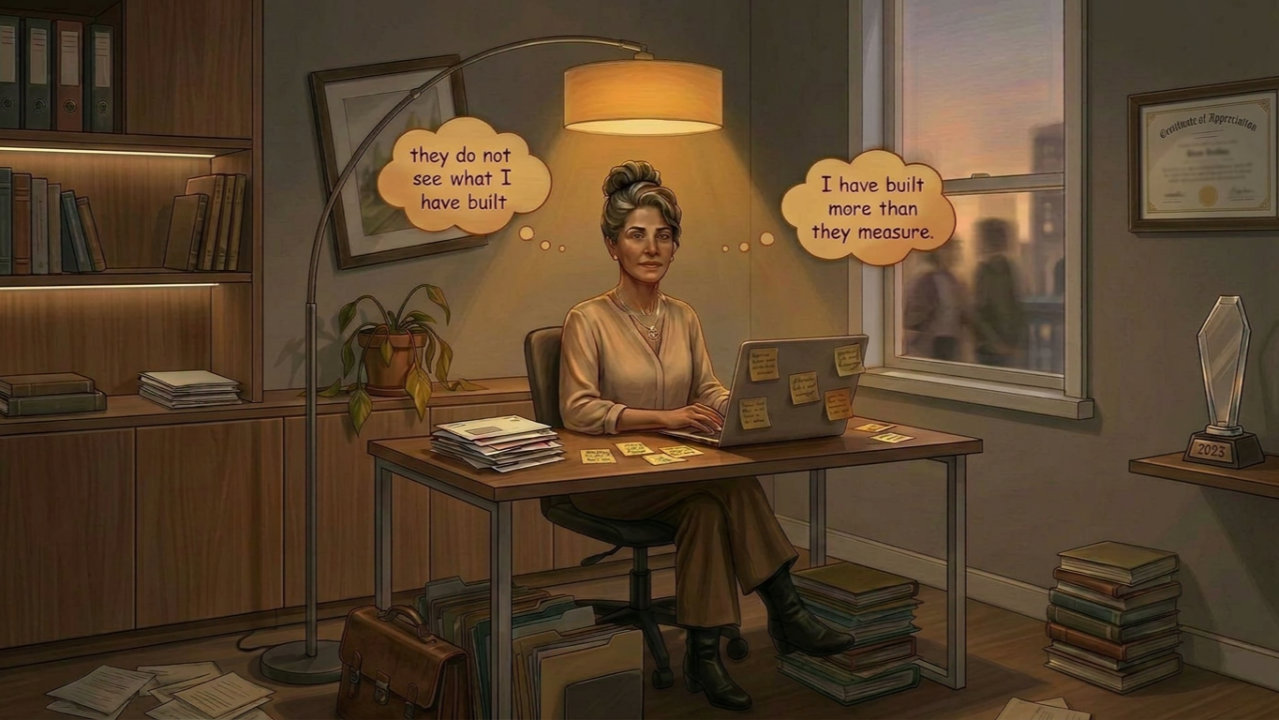
The press is calling it job hugging. ManpowerGroup's 2026 Global Talent Barometer reports that 64% of workers plan to stay with their current employer. A ResumeBuilder survey found 57% of U.S. workers identify as job huggers, up from 45% six months earlier. The economic read is real. It is also incomplete.
What the data is registering on the surface is a holding pattern. What is producing the holding pattern underneath is something the press has not yet connected to the behavior. AI implementation is one the catalyst.
Every AI implementation is a measurement-system change disguised as a productivity upgrade. The tool does not arrive in a neutral workplace. It arrives inside an organization already counting some forms of professional value and ignoring others and the implementation reorders that count. Speed, technical fluency, and output volume become more visible. Judgment, anticipation, stabilization, and the institutional weight that has been carried for years become harder to see. The shift does not announce itself. It creeps in through dashboards, new performance metrics, meeting notes that begin to mirror the categories the tool produces, and the quiet narrowing of what gets named as valuable in the room.
The research community has begun documenting this. IMD's work on the AI productivity illusion describes how validation effort goes unmeasured and invisible in the efficiency story. Solutions Review names it as an identity crisis at the heart of AI transformation.
The experienced professional registers this reordering, often before leadership names it. Sometimes the registration is conscious. Sometimes it shows up as discomfort, hesitation, a sense that something is off, without language for what is being noticed. The hesitation is not a failure to adapt. It is the accurate response to a measurement system that has begun to operate inside the workplace before the workplace has caught up to it.
This is Quiet Technophobia®. It is what happens when an experienced professional registers that the work environment has begun measuring them by a system that does not see what they have been building. The technology in front of them is not the threat. The threat is the measurement shift the technology installs. Their hesitation is not a failure to adapt. It is an accurate response to a reordering that their organization has not yet named, that their job description has not yet caught up to, and that the language of the workplace has not yet given them a way to articulate. This is the first time the construct has been formally defined in this newsletter, though the condition has been visible across every issue.
I know this because I lived it before I had language for it. For years I worked inside environments where my value showed up in execution, judgment, diplomacy, and the institutional weight other people often did not notice was being carried. This was not loud authority. It was operational authority. I was handed antiquated processes, fragmented workflows, and pressure from multiple directions. My instinct was never collapse. It was redesign. The role did not contain me because of the title. The role contained me because the work made my intelligence legible to the people around me.
Then the measurement changed. What AI disrupted was not only my workflow. It disrupted the container where my intelligence had always been validated. Suddenly the things I had spent years mastering were invisible to systems that only measured output speed or technical fluency. Meanwhile, the actual thing that made the work exceptional was what I later coined Living Knowledge. The judgment layer. The witness layer. The human interpretation layer. The container that had always rewarded those things was being replaced by a measurement that did not see them. In my opinion, that registration is what produces the hug in AI disruption.
Issue 9 of this newsletter named the silence inside organizations that have not said anything about AI and what that silence costs the worker who is reading it. The Hug That Holds You Back is what that silence produces when it sits on a professional long enough, and when an AI implementation has installed a measurement system the workplace is now operating under without acknowledging what it has changed. The professional does not leave because the silence has not lifted and the new measurement has not yet caught up with what they have actually built. Their external record has not caught up with their internal state. The longer they stay, the wider that distance grows. The wider the distance grows, the harder it becomes to leave.
This is one of the quietest professional griefs people carry right now, especially in the middle of AI disruption. When technology reshapes work, it does not only threaten tasks. It threatens the environments where people learned who they were.
The mid-career professional reading this has spent decades becoming extraordinary in ways that were never formally documented. Their value lives in calibration over time, in reading rooms before reading reports, in catching what nobody flagged, in stabilizing systems that were never designed to stabilize themselves, in carrying weight that left no paper trail.
Some hiring systems do a terrible job recognizing that kind of intelligence once it is removed from the environment where it was formed. So, they stay. Not always because they love the work. Sometimes because the role became the only mirror reflecting back who they had become. Sometimes because the people in the building still operate with the prior measurement in their memory and that memory is the only place their full value is still legible.
What the data is reading as a hedge is also a kind of holding pattern. Stay long enough for someone to see what you have actually integrated. Stay long enough for the silence to break. Stay long enough for the new measurement to make room for what the prior measurement could see.
The problem is that the silence does not break on its own. The longer the hug holds, the more invisible the integration becomes, even to the professional doing it. They start to wonder whether what they have built is real outside the room they built it in. That doubt is not a weakness in them. It is a feature of the conditions they are operating inside.
I am writing this newsletter because I recognized myself in it before I had words for the recognition. I built PRONOIA because I watched too many capable professionals start to distrust the value of their own minds inside environments that had quietly stopped measuring what made them exceptional in the first place. The hug is what happens after that distrust takes hold. The container is still standing. The professional is still inside it. But the conditions that made the container worth staying in have shifted and the language for what they have actually become has not arrived yet.
Quiet Technophobia may not end when you started using AI. It can change shape. The first version pulls you away from the entry point. This version pulls you toward staying still. Same registration, different mask.
The work of the next year is to make yourself integration legible while you are still inside the building. The work is to give you language for what you have actually become, in your own voice, in your own time, so that the decision to stay or to leave is yours to make from a position of being seen rather than being hidden. The hug is not the problem; being invisible inside the hug is.
To learn more visit: www.inclus-ai.com.