More than half of government organizations are now using AI. Fewer than half have a formal policy governing how it should be used. That number comes from Granicus research published this month and it is not an edge case. It is the current operating condition for administrative professionals across industries, sectors, and organization sizes. The tools are deployed. The expectations are shifting. The governance that would tell workers what they are allowed to do, what they are accountable for, and what support they can expect has not arrived.
That means someone is making judgment calls without clear guidance. Someone is deciding what is acceptable, what is risky, and what is effective. They are also absorbing the consequences if they get it wrong. In many organizations, that someone is an administrative professional and that risk was never formally assigned to them.
For administrative professionals, Quiet Technophobia® rarely sounds like, “I’m afraid of AI.” More often, it sounds like, “I don’t know if I’m allowed to bring this into a relationship built on trust. I don’t know whether using it violates policies nobody has explained. I don’t know whether it will change how people understand the expertise I have spent years building.” The hesitation is not a lack of capability. It is the weight of protecting trust, navigating ambiguity, and preserving the value of Living Knowledge in a moment of profound change.
This is what makes the governance gap so consequential. In the absence of clear guidance, administrative professionals are left to negotiate permission one relationship at a time. They weigh whether introducing AI might alter how an executive sees their judgment, expose them to consequences for rules that were never defined, or invite questions about expertise they have spent years earning. The silence that follows is often misread as resistance. More often, it is a rational response to uncertainty that nobody has helped them navigate.
The governance gap is not abstract.
Deloitte's 2026 Global Human Capital Trends research found that organizations taking a tech-first approach to AI were 1.6 times more likely to fail to realize returns above expectations than those using a human-centric approach. The difference was not the sophistication of the technology. Organizations with access to the same capabilities produced different outcomes depending on whether they prepared the people expected to use them.
For administrative professionals, that finding lands differently than it does for a software team or a finance department. Administrative work is coordination work that sits at the intersection of people, process, and information, which means the judgment calls happen constantly, not occasionally. When the governance is missing, every judgment call about AI becomes a risk calculation the admin is making alone, without institutional backing, without a clear framework, and without any way to know whether they are doing it correctly.
The question underneath the hesitation is rarely, “Can I do this?” It is, “Am I allowed to do this and what happens if I get it wrong?”
The Strada Institute published research in May 2026, finding that more than 40% of employers say AI has increased analytical responsibilities for entry-level workers, while nearly the same share say it has reduced routine administrative tasks. The work is already changing. The policies that would help people navigate that change have not kept pace and the risk of navigating that gap has been redistributed to the people closest to the work and furthest from the policy table.
What the permission gap actually costs.
In April 2025, Google published findings from their AI Works pilot program conducted across small businesses, educational trusts, and a union in the United Kingdom. Workers who were given explicit permission to use AI tools and a few hours of structured training saved an average of 122 hours per year on administrative tasks alone. Before the pilot, two thirds of UK workers had never used generative AI at work, with the widest gap among women over 55.
Google’s EMEA president described what she heard consistently across the cohorts. People wanted what she called “permission to prompt.” They were asking themselves whether it was acceptable to use these tools in their roles at all. Three months after receiving that permission and basic training, adoption among women over 55 jumped from 17% weekly usage to 56%.
That is not simply a technology adoption story. It is a story about what happens when people no longer have to choose between curiosity and caution, innovation and trust. The capability was already there. The willingness was already there. What had been missing was clarity.
The organizations sitting inside the current governance gap are leaving that same shift on the table. The administrative professionals carrying the operational knowledge of those organizations are improvising in silence while absorbing ambiguity that belongs to leadership.
The ask that changes everything.
Most organizations will not close the governance gap from the top down quickly enough to matter for the professionals navigating it right now. Policy cycles move slowly and administrative professionals have spent entire careers moving work forward before the systems around them caught up. They build the bridge while people are still debating whether one is needed and AI is no different.
What can move is a single conversation, not a policy proposal, not a formal request routed through channels, but a direct and prepared exchange between an administrative professional and the person they support. Most administrative professionals have never had this conversation because nobody has given them a structure for it. Insight without a path forward rarely changes anything.
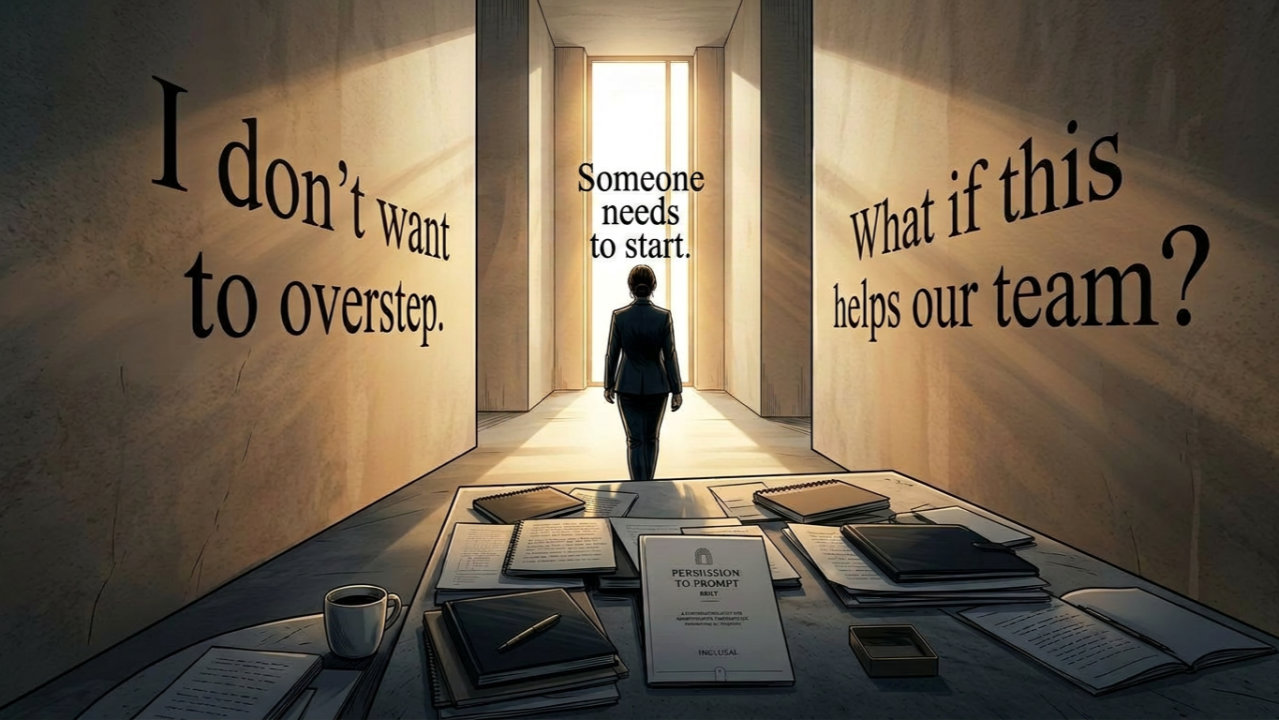
The Permission Brief was built for exactly that moment. It is a one-page professional document designed to help administrative professionals bring AI into one of the most trust-based relationships in the workplace without risking the relationship itself. It gives them a way to initiate the conversation openly, ask thoughtful questions, clarify expectations, and explore possibilities together rather than in secret. Not because they lack judgment. Because their judgment matters enough to deserve a conversation.
The 122 hours are already there, the capability is already there, and the professionals are already there. The risk of AI adoption was never eliminated. It was redistributed, often to the people closest to the work and furthest from the policy table. The risk was redistributed without your consent. If you have hesitated; it may not be because you doubted your ability to learn. It may be because you were trying to protect the trust you had built, navigate policies that were never made clear, and preserve the value of expertise you have spent years developing.
The Permission to Prompt Brief was built for that moment. Not to bypass judgment but to honor it. Not to replace your Living Knowledge but to bring it into the conversation. You do not have to carry the question alone. Sometimes the first act of readiness is simply asking for permission out loud.