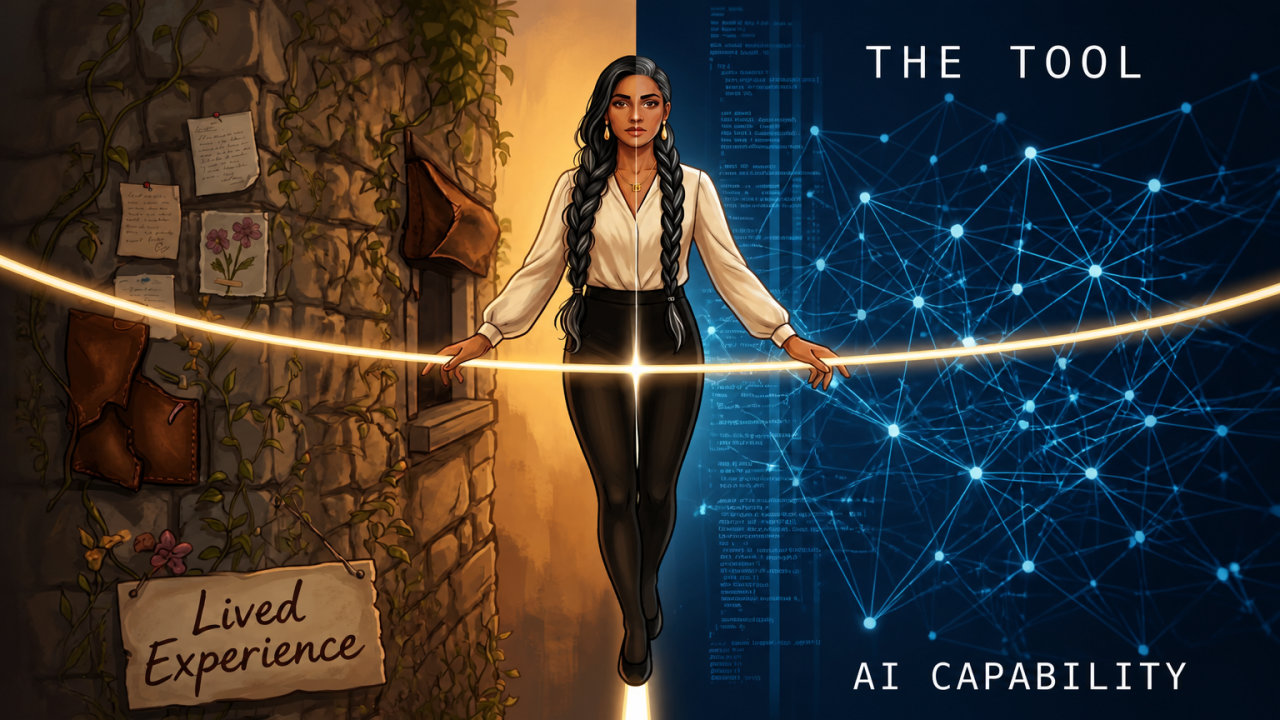
The workforce conversation around AI keeps focusing on whether professionals are willing to adopt the technology. That is only one layer of AI adoption readiness. Because readiness is not a single moment that happens before adoption. It is an ongoing calibration relationship between the professional and the technology.
Many professionals have already crossed that threshold. They are using AI every day, writing with it, researching with it, organizing with it, and building workflows around it. Some have become highly efficient with it in a very short amount of time.
The deeper issue is what happens after adoption begins. Because there is a growing difference between simply using AI and walking the tightrope of remaining properly connected to your own Living Knowledge while using it. That difference matters more than most organizations realize.
A recent GoTo workplace report found that nearly half of employees now believe they rely too heavily on AI, while many also expressed concern that AI may be weakening their critical thinking and problem-solving abilities over time. Most organizations will interpret those findings as an overreliance problem. I do not think that is what we are actually looking at.
What we may be seeing instead is a workforce struggling to properly calibrate the relationship between AI capability and Living Knowledge authority. A professional can absolutely trust their expertise enough to begin using AI and still gradually lose awareness of when that expertise should remain the governing authority inside the interaction.
That is where overreliance starts forming, not from incompetence, not from laziness, and not from lack of readiness, but from a lack of calibration between AI capability and Living Knowledge authority. Yet almost nobody is talking about it this way.
Experienced professionals built their judgment over years of lived repetition, through nuance, through mistakes, through context, through pattern recognition, and through reading situations in real time and understanding things that cannot always be documented inside a process manual or generated through a prompt.
That accumulated professional intelligence is Living Knowledge. Living Knowledge Integration is the practice of working with AI in real time while remaining anchored in your own judgment, allowing your decisions, thinking, professional instincts, and lived experience to shape the interaction rather than being replaced by it. It is not learning before action or applying knowledge after the fact. It is learning through the act of working itself, where every interaction with the system becomes a continuation of Living Knowledge and an expansion of the professional's capacity to think, discern, decide, refine, and lead in real time.
The problem is not that professionals no longer trust their Living Knowledge exists. The problem is that many do not fully recognize its governing role once AI enters the workflow, and so the interaction subtly changes.
The professional begins consulting AI before consulting themselves. They ask the tool to validate decisions they were previously capable of making independently. They begin mistaking speed for certainty.
The output sounds polished, organized, immediate, intelligent. Moreover, because the interaction happens so quickly, the professional slowly stops noticing where their own judgment was supposed to intervene.
This is where dependency drift begins, not as dramatic dependence but as quiet dependence. The kind where the professional still appears highly functional from the outside while internally becoming less connected to their own interpretive authority.
Yet this is where the conversation around AI mastery is still incomplete. Because mastery is not simply knowing how to use AI. Mastery is being able to use AI without allowing the system to quietly become the dominant thinking layer inside the interaction.
The goal of readiness is not to allow AI to lead the interaction. It is to help professionals use their Living Knowledge to lead it instead. That is the calibration nobody taught the workforce.
Most professionals were taught how to use AI. Almost nobody taught them how to remain the governing intelligence while using it.
AI was never supposed to replace the governing role of human discernment. It was supposed to operate in partnership with it, with the professional's Living Knowledge teaching the AI how to operate within context, nuance, standards, lived experience, organizational reality, ethics, and situational judgment. That is what keeps the interaction governed instead of passive and what prevents technical fluency from quietly replacing discernment.
Organizations are currently measuring AI adoption across four layers: usage, depth, breadth, and segmentation, and usage remains the primary starting point for most, which means the measurement itself is incomplete from the beginning. Counting how often employees engage with AI, how many prompts are submitted, how much productivity increases, and how many workflows become automated reveals activity. It does not reveal whether the professional remains cognitively present inside the interaction and that is the real readiness question.
Can the professional still recognize when AI is accelerating the work, when AI is assisting judgment, and when AI has quietly become the dominant interpretive layer? Because those are not the same thing.
This is why some professionals may begin to feel a strange form of exhaustion around AI even while becoming more productive with it. Their expertise, intelligence, and Living Knowledge are still present but their relationship to it has become unstable. The speed of the system begins outpacing the speed of reflection, and when reflection disappears, discernment weakens.
That is not a software problem. It is a human calibration problem. The solution is not reducing AI usage or rejecting the technology altogether. The solution is helping professionals remain connected to their Living Knowledge while interacting with AI.
Helping them understand where AI is useful, where judgment must remain primary, where lived experience still governs interpretation, and where human discernment should override technical fluency. That is what readiness actually looks like.
Not fearlessness or resistance, and not blind trust in technology or in self. Calibrated interaction between AI capability and Living Knowledge authority is what readiness actually looks like in practice.
Indeed, that may become one of the defining professional challenges of this era, not whether people learn how to use AI, but whether they can continue hearing their own judgment clearly enough to know when the system is assisting their thinking and when it has quietly started replacing it.
Because Living Knowledge was never meant to disappear inside the interaction. It was meant to govern it.
The future of readiness may not belong to the professionals who use AI the fastest. It may belong to the professionals who learn how to keep their discernment, judgment, lived experience, and interpretive authority fully intact while working alongside it.
Because the real risk was never simply that AI would become more intelligent. It was that professionals might slowly stop recognizing that their own intelligence was still supposed to lead.
_________________________________________________________________________________________________
Full report page: https://www.goto.com/resources/pulse-of-work-2026
Business Wire press release with the key stats: https://www.businesswire.com/news/home/20260519052491/en/Half-of-Employees-Say-They-Rely-Too-Much-on-AI-39-Say-It-Is-Making-Them-Less-Intelligent-According-to-New-Research-From-GoTo