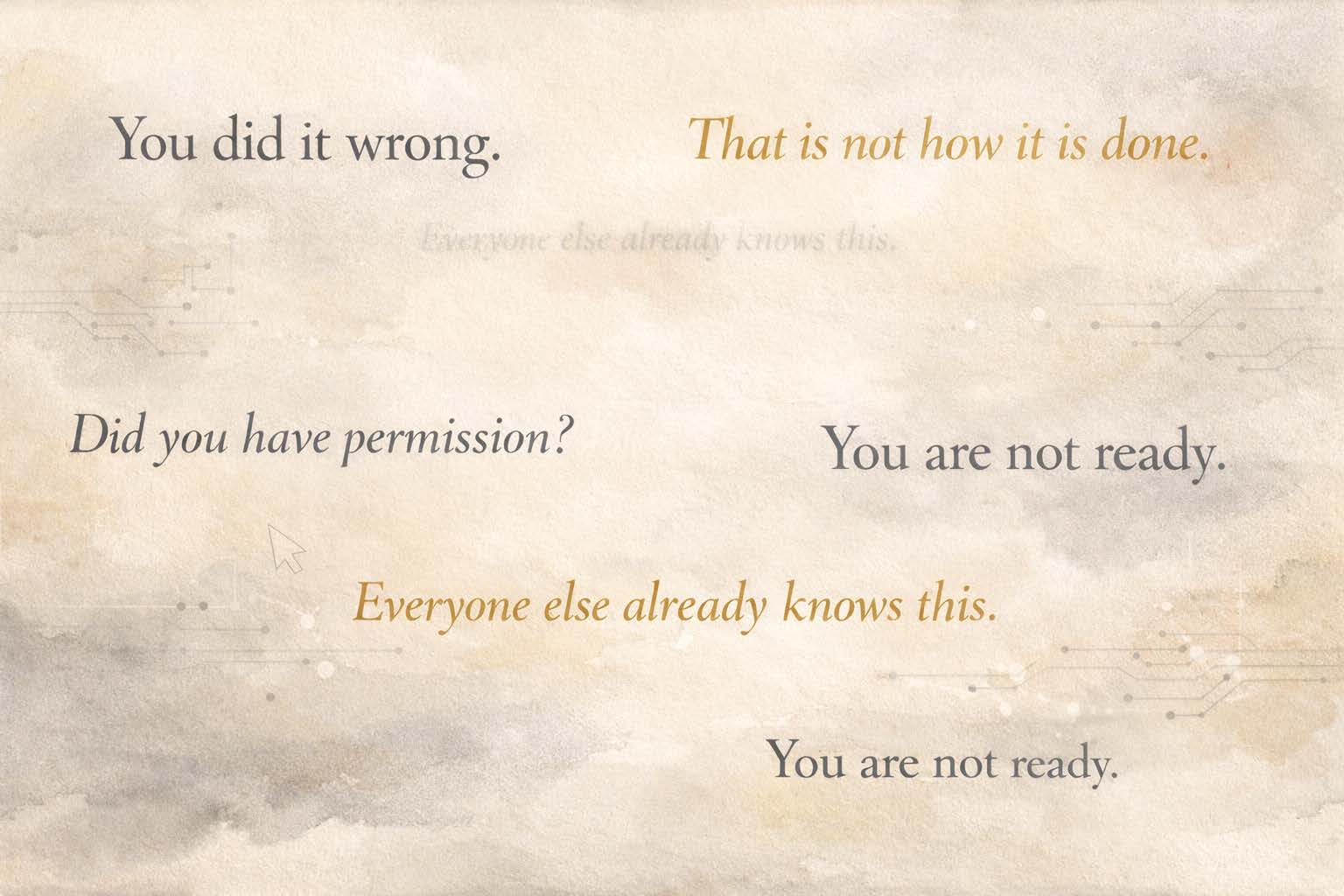
Not long ago I came across a LinkedIn post from someone I had followed for a while. Someone I associated with AI adoption, with opening doors, with moving people forward. Presented as a helpful tip from an expert and a gentle hand on the shoulder.
But in essence, it was simply a list of things untrained users were doing wrong.
I sat with that for a moment. Not because the criticism landed. Because of who it came from and how it was delivered. This was someone who built a career around AI adoption advocacy, now policing the fingerprints AI leaves behind. The message underneath the helpful framing was clear. There is a right way to arrive. And you are not doing it.
That is the moment I had a name for something I have been witnessing for far too long.
I call it Process Purity.
Process Purity is the doctrine that says how you get there matters more than that you get there. It is not always stated directly. It rarely is. It shows up in the framing of advice, in the tone of feedback, in the quiet hierarchies that form inside professional communities where some paths to a result are celebrated and others are quietly dismissed. It is externally imposed. The dangerous part is how quickly it becomes internal. People stop asking whether they belong in a conversation. They already know the answer someone handed them.
In tech and AI spaces, Process Purity has a culture built around it. I call that culture Caste Coding, a hierarchy of belonging based not on what you produce but on how you produced it. The tools you used. The path you took. The credentials behind your name. The people who maintain that hierarchy, often without realizing they are doing it, are Caste Coders. They are the ones who decide, usually without saying so directly, which methods are legitimate and which are not. They are not always hostile. Sometimes they are genuinely trying to help. But the effect is the same. You did not come through the right door, so your arrival does not count.
This is bigger than tech. The Credentialed Class is the wider pattern that Caste Coding reflects. It tends to exist in professional and informal spaces where a formal title, a specific degree, or a recognized path is used to determine whose work deserves to be taken seriously. Where the question is never what did you build, but how did you build it, and did you have permission to try.
Scientists who study childhood bullying have found something that goes beyond the hurt of the moment. When kids are repeatedly excluded or rejected by their peers, they do not just feel bad. They change. They start pulling back on their own, before anyone has a chance to push them out again. The exclusion becomes a lesson they teach themselves. Stay small. Do not try. You already know how this ends.
In adults dealing with workplace bullying, researchers found the same pattern, but it shows up differently in professional settings. It rarely looks like someone screaming at you across a conference table. It looks like a series of small things. A comment framed as feedback. A tone that implies you missed something obvious. A list of mistakes that people like you tend to make. None of it is dramatic. All of it adds up. And what it adds up to, according to researchers, is damage to how people see their own competence. Not from one big blow, but from enough small ones that eventually you stop needing anyone to question you. You do it yourself.
That is the mechanism. That is what Process Purity produces. Not a confrontation. A conditioning.
This is a subset of what Quiet Technophobia looks like from the inside. Not fear of technology. Fear of being wrong about how you use it. It is just one of many AI adoption obstacles handed to mid-career professionals by a culture that measures method, rewards credentials, and quietly signals that some paths to a result do not count.
That conditioning does not appear on its own. Someone delivers it.
If you recognize your own behavior in what was just described, this part is for you. The corrections you post about what untrained users are doing wrong. The tone that implies there is a right way to arrive and everyone else is still working up to it. You may not recognize yourself here, and most Caste Coders do not, because the intent was never to exclude. But the people on the other side of that content feel the hierarchy whether you designed one or not.
And the ones you are losing are exactly the ones you said you wanted to reach. Mid-career professionals. Career changers. People who came late and came anyway. Every time the message you send reduces to you are doing it wrong instead of you are doing it, someone decides the door was not meant for them. The harm is not in what you meant. It is in what they walked away carrying.
PRONOIA was built as a counter to that conditioning. Not as inspiration, but as a doctrine that replaces the ones that were installed without permission. Where Process Purity says your method determines your worth, PRONOIA says the universe already conspired to get you here. Your path was valid before anyone weighed in on it. You are not measured by how you arrived. You are awarded by the fact that you did.
The whole point is not how you get here. It is that you get here.
Sources
Oh, W., Rubin, K. H., Bowker, J. C., Booth-LaForce, C., Rose-Krasnor, L., & Laursen, B. (2008). Trajectories of social withdrawal from middle childhood to early adolescence. Journal of Abnormal Child Psychology, 36, 553–566.
Tracy, S. J., Lutgen-Sandvik, P., & Alberts, J. K. (2006). Nightmares, demons, and slaves: Exploring the painful metaphors of workplace bullying. Management Communication Quarterly, 20(2), 148–185.
Lutgen-Sandvik, P. (2008). Intensive remedial identity work: Responses to workplace bullying trauma and stigmatization. Organization, 15(1), 97–119.
Agervold, M., & Mikkelsen, E. G. (2004). Relationships between bullying, psychosocial work environment and individual stress reactions. Work and Stress, 18(4), 336–351.