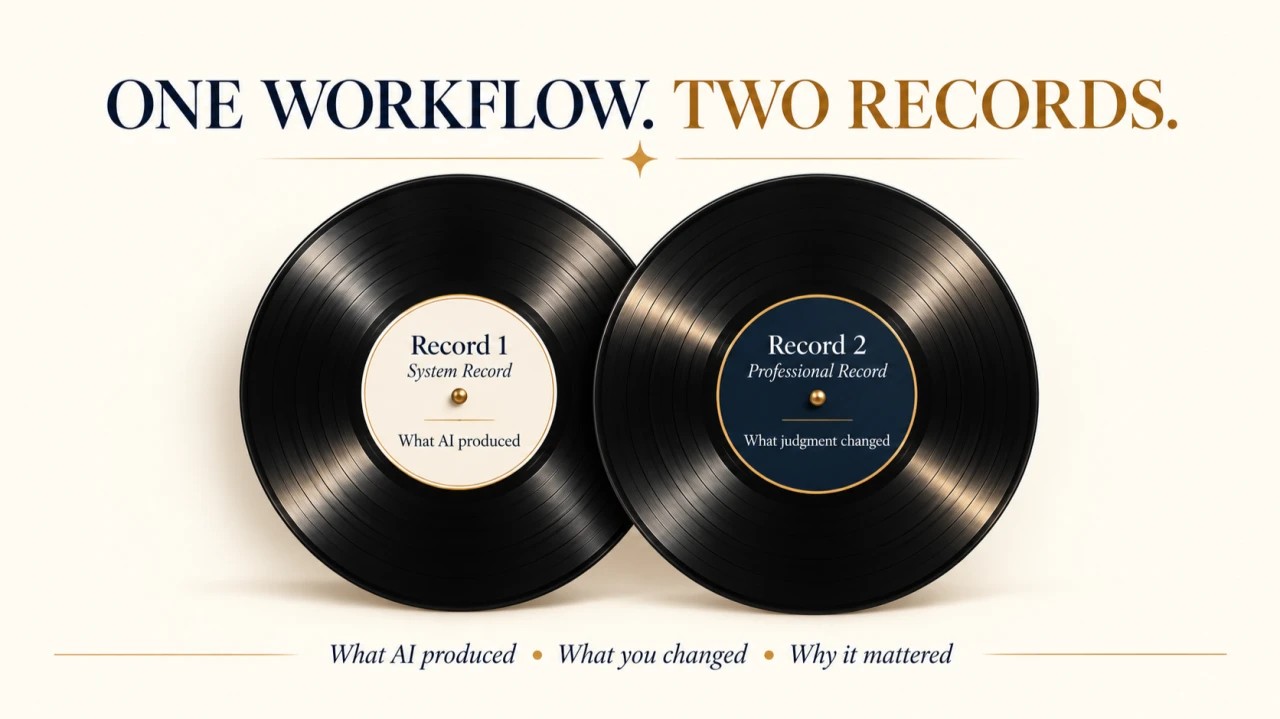
During my ES Tech 2026 session, we left one question underneath the conversation about AI adoption: what happens to the professional judgment that made the work usable after the deliverable leaves the desk? The system keeps a record. The judgment often does not. That is the problem behind One Workflow. Two Records.
Every AI-assisted workflow has two records. Record One is the system record. It shows what was generated, completed, scheduled, summarized, sent, or delivered. Record Two is the professional record. It holds what could be trusted, what needed context, what required correction, what had to be calibrated, and what should never leave the organization in the form AI produced it.
Both records exist. Only one reliably travels.
When Support Becomes Absorption
Research on organizational learning helps explain what happens next. Tucker and Edmondson distinguished first-order problem solving, the immediate local fix that keeps work moving, from second-order problem solving, where the underlying cause is surfaced so the system can learn. When local recovery becomes routine without that second step, an organization can maintain performance while failing to become more capable. They called this an "illusory equilibrium."
In AI-assisted work, absorption is one mechanism through which that equilibrium forms. Someone close to the work closes a gap nobody assigned and the correction disappears with the deadline.
Not every correction is absorption. Support is requested, visible, and assigned. Absorption is unasked, unrecorded, and recurring.
That distinction prevents the easy conclusion that human involvement means AI failed. Brynjolfsson, Li, and Raymond found real productivity gains in a study of 5,172 customer-support agents, with particularly strong benefits for less experienced workers. Human review and judgment can be part of the workflow working as designed. The question is whether the organization can tell designed support from recurring absorption.
Star and Strauss showed how necessary background, articulation, and repair work can disappear from the official representation of a process. Add AI and the issue sharpens. A professional can recognize that an answer is technically correct but contextually wrong. They restore institutional history the model does not hold. They know that a stakeholder relationship changes the wording, that a policy exception changes the answer, or that information should not leave the organization at all.
Sometimes there is an error to correct. Sometimes there is not. Record Two is larger than repair. It is the record of professional judgment, the context, calibration, restraint, trust, and discernment that make Living Knowledge visible in the moment of work.
Detection Is Not the Same as Escalation
A July 2026 simulation study of 80 hospital nurses shows why Record Two tends to stay at the desk. They detected 96.2 percent of the operational failures placed in front of them yet second-order problem solving occurred only 21.9 percent of the time. Nurses identified time pressure, normalization of deviance, and absent feedback loops among the structural barriers.
People can see the failure and still have no reliable path for what they know to travel upward. That pattern matters for AI-assisted work because the professional closest to the output is often the first to see where context is missing, where a boundary has been crossed, where an exception is forming, or where the workflow required more human judgment than the system record shows.
Recent AI research suggests that judgment is not simply disappearing. Lee et al. (2025), in a study of 319 knowledge workers across 936 GenAI-assisted work examples, found that critical effort shifted toward verification, integration, and task stewardship.
Glean's 2026 Work AI Index called some of this labor "botsitting," including supplying context, checking outputs, debugging, rerunning prompts, and cleaning erroneous results. Its survey of 6,000 digital workers estimated 6.4 hours a week of that work on average. Glean is an AI vendor so I treat the number as industry survey evidence rather than a universal benchmark. The useful signal is the category: human effort can accumulate between AI output and usable work without appearing in the completion metric.
Silence Can Make the Record Look Cleaner Than the Work
Quiet Technophobia® matters here because Record Two depends on more than detection. It depends on whether professionals believe there is permission to surface what they saw, changed, questioned, or stopped. A clean system record can coexist with a much messier professional one when the person holding contradictory evidence has no clear permission, language, or receiver for it.
The Witness Function is the act of naming what is already present in someone before they can claim it themselves. Turned upward, it gives Record Two somewhere to go.
That does not require publishing every correction or building another administrative burden around AI use. The professional who restored the context, calibrated the response, or stopped the wrong output already holds the record. The organizational challenge is whether that judgment can reach someone positioned to recognize what it means.
A Stronger Record of Readiness
I have not found a peer-reviewed study that directly tests whether AI adoption dashboards overstate success because unrecorded human judgment absorbs recurring workflow gaps. What exists around that question is substantial: invisible work, workarounds, first- and second-order problem solving, automation bias, verification, stewardship, and organizational learning.
The open question is not whether judgment exists. It is whether organizations can see enough of it to learn.
Record One tells leadership that the work moved. Record Two tells leadership what professional judgment had to carry so it could move well.
When only the first record travels, readiness gets read from the outcome backward. When both records travel, leadership gains access to the context, calibration, restraint, correction, and judgment already operating inside the work.
Readiness should travel upward as evidence and downward as infrastructure. One workflow. Two records. Both belong in the conversation.
To find out more, please visit my website.
Sources
Tucker, Anita L., and Amy C. Edmondson. "Why Hospitals Don't Learn from Failures: Organizational and Psychological Dynamics That Inhibit System Change." California Management Review 45, no. 2 (2003): 55–72. https://journals.sagepub.com/doi/10.2307/41166165
Star, Susan Leigh, and Anselm Strauss. "Layers of Silence, Arenas of Voice: The Ecology of Visible and Invisible Work." Computer Supported Cooperative Work 8 (1999): 9–30. https://link.springer.com/article/10.1023/A:1008651105359
Lee, Hao-Ping (Hank), et al. "The Impact of Generative AI on Critical Thinking: Self-Reported Reductions in Cognitive Effort and Confidence Effects From a Survey of Knowledge Workers." CHI 2025, Article 1121, 1–22. https://www.microsoft.com/en-us/research/publication/the-impact-of-generative-ai-on-critical-thinking-self-reported-reductions-in-cognitive-effort-and-confidence-effects-from-a-survey-of-knowledge-workers/
Glean Work AI Institute. Work AI Index 2026. https://www.glean.com/work-ai-institute/reports/work-ai-index
Brynjolfsson, Erik, Danielle Li, and Lindsey R. Raymond. "Generative AI at Work." The Quarterly Journal of Economics 140, no. 2 (2025): 889–942. https://academic.oup.com/qje/article/140/2/889/7990658
Vanbelleghem, Sem, Melissa De Regge, Yves Van Nieuwenhove, and Paul Gemmel. "Embedding Sustainable Second-Order Problem-Solving Behaviour in Hospital Nurses via Simulation-Based Education." Journal of Advanced Nursing. Online ahead of print, July 26, 2026. https://onlinelibrary.wiley.com/doi/10.1111/jan.70693