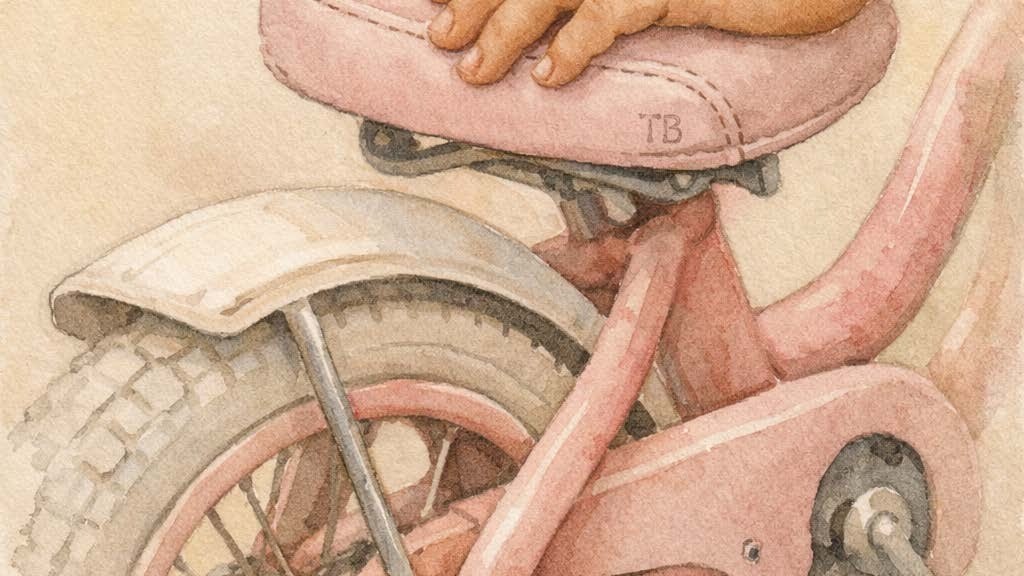
I learned to ride a bike the way most people do. My slightly older brother held the back of the seat. Not the handlebars. Not the pedals. Just the seat. Enough contact to keep me upright while I figured out the balance for myself.
He didn't explain physics. He didn't talk about momentum or center of gravity or what my legs were supposed to be doing. He just walked behind me, hand steady, until I stopped wobbling.
Then, at some point, he let go. I didn't even notice. That's the part nobody talks about. The letting go was so quiet that by the time I looked back, I had already been riding on my own.
This is PRONOIA and how it was born. One pedal (prompt) at a time. Wobble (iteration) after wobble (iteration). Grip, release, adjust, try again. Not one clean ride. A hundred small ones that eventually became balance.
I think about this every time someone tells me they haven't started with AI yet.
Not the people who are already fluent. Not the ones who downloaded every tool the week it launched. I'm thinking about the person who knows they probably should. Who's watched the conversation move faster and faster while they nod along, planning to look into it later.
Later keeps moving.
Moreover, this is not a small number of people standing still. ManpowerGroup's 2026 Global Talent Barometer found that AI usage jumped 13 percent while confidence in using technology fell 18 percent. The tools are arriving faster than the steadiness. For Baby Boomers, the confidence drop was 35 percent. For Gen X, 25 percent. The people with the most experience are the ones who feel the most unsteady.
That person doesn't need another tutorial. They don't need a ranked list of tools. They don't need to be told to hurry up.
They need a hand at the back of the seat.
Not pushing.
Not pulling.
Just steady enough that the first wobble doesn't become the reason they stop.
I know this because I was that person.
Mid-career. Experienced. Capable in most rooms I walked into. Yet suddenly unsure in this one. The stillness in me wasn't resistance. It was the weight of beginning again. Nobody around me was talking about that part. They were talking about speed, tools, and capability. The conversation had already moved on.
So I started alone. One quiet afternoon. I opened an app. I typed something. Something came back that made me type again.
The wobble (prompt engineering) was real.
I wasn't sure I was doing it right. I adjusted. I tried again. I overcorrected. I loosened my grip. I kept going.
Then something shifted.
It didn't feel like learning something new. It felt like recognizing something I had carried my entire career. Anticipating needs. Translating ideas. Solving problems before they surfaced. Only now there was something that could keep up.
That was the balance.
PRONOIA didn't come from mastering technology. It came from finding steadiness inside it.
Training wheels are not weakness. They are a structure for transition. A bridge between knowing and doing. There is always a moment when the rider realizes the hand isn't there anymore. They are riding on their own.
I think about that same wobble when I hear people talk about Human-Centered AI.
We describe human-centered systems with words that feel solid. Safe. Ethical. Transparent. Trustworthy. Accountable. Those commitments matter. They shape how intelligent systems are designed and how they serve people.
But here is what I keep coming back to.
Those words are not fixed. They are not technical descriptions. They are human judgments shaped by context, experience, and the reality of the person sitting in front of the screen. What feels safe to one person may not feel safe to another. What builds trust in one environment may create hesitation in another. What is helpful in one context may feel destabilizing in the next room over.
Human-centeredness is not a formula you solve once. The value is not in the question alone. It lives in the human answering it. Moreover, that answer changes depending on who is sitting in front of the screen.
I did not have the academic vocabulary for this when I started building. I just knew what I felt. Indeed, what I felt was that every conversation about responsible AI assumed the human was already in the room, already seated, already ready to participate.
Nobody was asking whether I felt steady enough to sit down in the first place.
Human-Centered AI focuses on how systems should behave in relation to people. That is critical work. But PRONOIA sits in a different chair. It focuses on how people feel inside that relationship. Whether they trust themselves enough to engage. Whether they believe the system was built with them in mind. Whether the wobble is going to make them quit or make them curious.
Human-Centered AI asks: how do we build responsible systems?
PRONOIA answers back: the person has to be steady enough to participate first.
That is not a disagreement. It is a complement.
Because being "human-in-the-loop" assumes something. It assumes the human feels grounded enough to engage. Confident enough to question. Secure enough to experiment. Balanced enough to keep going when the first wobble shows up.
Still, the wobble is real. I have felt it. I have watched other people feel it. It does not show up on a dashboard or in an adoption metric. It shows up in the pause before someone opens the tool. In the tab that gets closed three seconds after it opens. In the meeting where someone nods but never tries.
Human-Centered AI builds the bicycle responsibly. PRONOIA is the hand at the back of the seat.
Then, when balance transfers internally, something important happens. The human does not just use the system. They shape it. They bring judgment. They bring context. They bring the kind of pattern recognition no training module installs.
PRONOIA does not teach AI. It teaches you how to trust yourself inside it.
Most training begins with the tool. PRONOIA begins with the person. It asks what is keeping you still before it asks you to move. Because if you skip that part, you may learn the commands but never build the confidence to use them when it counts.
Confidence is not something that gets installed during onboarding. It transfers. Slowly. Through wobble after wobble after wobble, until one day you look back and the hand is not there anymore.
You are riding on your own. Not because someone pushed you. Because balance became yours.
You were never behind. You were just waiting for the right hand at the back of the seat.
If your organization is navigating this, I would welcome the conversation.