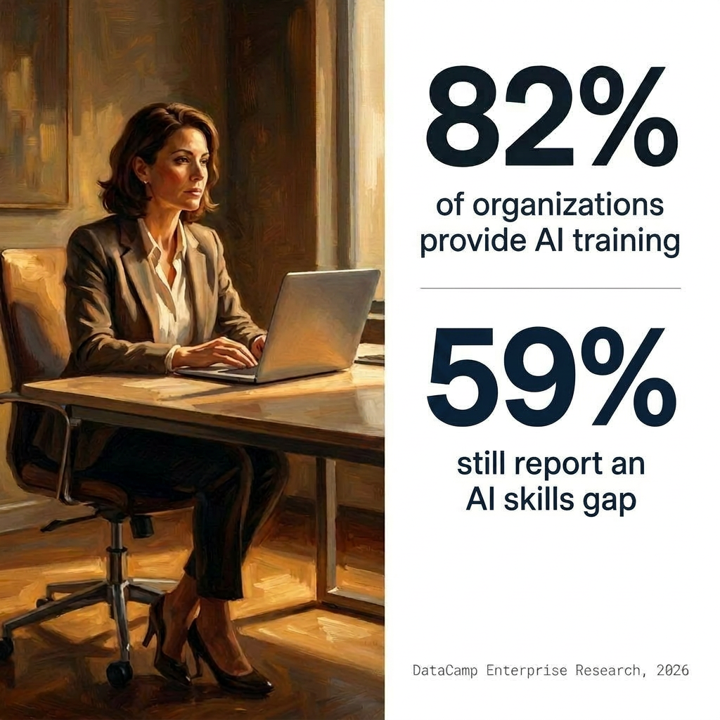
There was a moment I remember clearly even though nothing dramatic happened in it.
I had been using AI more consistently, building it into my daily rhythm, expecting that repetition would do what repetition usually does. This was supposed to make me sharper and more certain.
But instead, the opposite started happening.
I would get a response back and instead of relief, there was a pause. A small internal hesitation. I would ask myself, "Is this actually right?" Then came a second layer beneath that one, quieter and more unsettling. Would I have caught that before? The answers were not bad. Some of them were genuinely good, polished in a way that made them easy to use. Yet somehow that made the feeling worse because now I was not just doing my work. I was evaluating something that looked like it already knew how to do my work and doing it without visible effort.
The doubt that followed was not loud or panicked. It was steady and low, the kind you carry without announcing it. Am I missing something? Is this better than what I would have done? If I trust this and I am wrong, is that on me?
That is what I did not expect. Quiet Technophobia® does not always stay in the doorway. Sometimes it follows you in. Once you give yourself permission to finally engage, it does not disappear. It shifts. It finds new forms inside the experience, doubt wrapped in diligence, hesitation arranged as discernment, second-guessing groomed into quality control. The feeling changes shape but it does not leave the room.
Nobody warned me that getting better at something could feel, for a while, like getting worse at it. Yet that is exactly what was happening. The more I used it, the more aware I became of every gap, every moment I deferred to the output instead of my own judgment, every time I accepted something without fully interrogating it.
Practice was not building certainty. It was building visibility into everything I still did not know how to evaluate.
Before I understood what was actually happening, it felt like my footing was off. Not because I knew less but because something next to me could produce answers instantly, without showing its thinking, without the visible process that usually signals effort and care. It made my own thinking feel slower. Less certain. Even though it was not.
The hardest part was not the tool itself. It was the comparison I was making without realizing I was making it.
I was measuring my internal process against its external output.
However, that is not a fair comparison.
But in the moment, it does not feel like a measurement problem. It feels like falling behind something that does not get tired, does not hesitate, does not second-guess. So the feeling was not simply I do not know. It was closer to I thought I knew and I am no longer sure if that is still enough.
It took time to understand that what I was actually looking at was incomplete output, not complete thinking. That distinction changed everything. But until I had it, the confidence dip was real and it was quiet in the specific way that things are quiet when you do not have language for them yet.
This is not just personal. There is data behind it.
A 2026 ManpowerGroup study of nearly 14,000 workers across 19 countries put a number to what I had been carrying privately. Regular AI usage had climbed but confidence in using technology had dropped sharply in the same period. The decline was not spread evenly. It was heaviest among the most experienced workers in the study, the ones who had built the deepest professional track records. Mara Stefan, VP of global insights at ManpowerGroup, described it plainly: workers are being handed tools without training, context, or support.
Randstad's 2026 Workmonitor captured the same pattern from a different angle. Worker self-assurance in handling new technology fell from 78% to 64% in a single year, a drop significant enough that researchers began describing it as the Great Workforce Adaptation, a moment where the pace of technological change had outrun the support structures organizations were providing to help people keep up.
Neither report described a workforce that had failed. Both described a workforce that had been set up to feel uncertain by the conditions surrounding it and not by any deficiency in its own capability.
Here is what I took from that. When I had spent years developing professional judgment, I had built an internal standard. I knew what good work felt like from the inside. I knew when something was off before I could fully explain why. That internal calibration was not a weakness. It was the result of thousands of hours of paying attention and course-correcting in real time. But AI output does not show its thinking. It arrives polished and complete, without the visible hesitation or revision that usually signals a thinking process in progress. When I placed my internal, visible, uncertain process next to its external, invisible, confident-looking output, the comparison felt lopsided. My doubt looked like a deficit. Its certainty looked like competence. Neither reading was accurate but the feeling was persistent.
My Living Knowledge was being put to the test.
What I was actually doing when I paused to evaluate the output was not falling behind. I was doing the most important part of the work. I was applying the judgment the tool does not have, the ability to assess whether what came back was actually right for this situation, this person, this context, this moment. That evaluation was not a sign that the tool was better at the work. It was evidence that I was still the governing intelligence in the room.
The confidence dip is not a signal that you are losing ground. It is a signal that you are doing more cognitive work than the people around you who are accepting the output without question. Moreover, right now, in an environment where AI can produce convincing answers to questions it does not fully understand, the ability to pause and evaluate is not a liability.
It is the most valuable thing in the process.
There is a name for what happens in that moment, not before you start but after you have started and the footing feels less solid than you expected. Understanding that moment is the first step toward standing differently inside it.
I call it PRONOIA. Not as a label. As a shift.
What feels like uncertainty is not the loss of your ability. It is the expansion of your awareness. The pause is discernment. The questioning is judgment. The awareness is expertise doing its work.
The footing did not vanish. It changed.
Then, once you understand that, you stop trying to feel certain the way you did before. You start trusting the way you think now.